David Hoffmann, PhD, College of Arts and Sciences Distinguished Professor of History, has earned The Ohio State University 2026 Distinguished Scholar Award. Senior leadership in the Enterprise for Research, Innovation and Knowledge recently surprised Hoffmann with the honor.

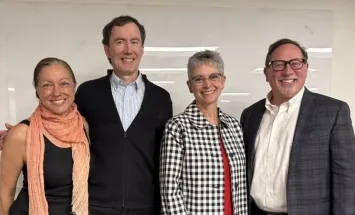
“The fact is our department is filled with distinguished scholars, and yet none would get recognized without the hard work of the Awards and Prizes Committee,” said Hoffmann. “So I want to thank the committee members.”
Hoffmann is a specialist in Russian and Soviet history, with a particular focus on the political, social, and cultural history of Stalinism.
“Your scholarship shows us not only how the Soviet government tried to engineer society, but how that structure is still used to shape politics in Russia today,” said Cynthia Carnes, senior associate vice president for research operations. “In a field where publishing influential books is the benchmark, you have published five scholarly monographs that are considered standard reading. Your second and third monographs established the modernity school in Russian history—completely redefining the study of Russian history.”
"I just want to congratulate you, David, and I am really happy to see you being awarded this wonderful honor," said Dana Renga, dean of arts and humanities. "While there are so many amazing things you’ve accomplished throughout your career, I'd like to also thank you for the work you have done in nominating and recognizing other colleagues and supporting their work, for example, through your service in the college’s promotion and tenure committee. Those were always such productive conversations."
In his letter of recommendation, History Department Chair Scott Levi wrote, “Professor Hoffmann has an outstanding record in terms of research, teaching, and service to the university and the profession. He is the consummate representation of what a Distinguished Scholar Award recipient ought to represent. I cannot think of a more deserving candidate.”
His most recent publications include an edited volume, The Memory of the Second World War in Soviet and Post-Soviet Russia (Routledge Publishers, 2022) and two monographs: Women, Gender, and Socialist Ideology in Soviet Russia (Routledge Publishers, 2026) and The Stalinist Era (Cambridge University Press, 2018). He is also the author of Cultivating the Masses: Modern State Practices and Soviet Socialism, 1914-1939 (Cornell University Press, 2011); Peasant Metropolis: Social Identities in Moscow, 1929-1941 (Cornell University Press, 1994); which won the Ohio Academy of History award for best book in 1995; and Stalinist Values: The Cultural Norms of Soviet Modernity, 1917-1941 (Cornell University Press, 2003), which analyzes Soviet official culture and the ideological and behavioral norms it was designed to instill. He is also the editor of Stalinism: The Essential Readings (Blackwell Publishers, 2002); and Russian Modernity: Politics, Knowledge, Practices (Macmillan Publishers Ltd., 2000). He recently received a John Simon Guggenheim Fellowship, and he is currently writing a monograph entitled World War II Memory in the Soviet Union and Putin's Russia. He has received numerous prestigious awards to support his research, including from the John Simon Guggenheim Memorial Foundation, the Woodrow Wilson Center, Harvard University, Stanford University, the National Endowment for the Humanities, the Social Science Research Council, and the American Council of Learned Societies. At Ohio State, Hoffmann teaches numerous courses on Russian History. For his many accomplishments in teaching and mentoring, he has received the 2013 Alumni Award for Distinguished Teaching, the 2010 and 2017 Phi Alpha Theta Teaching Award, the 2021 Ronald and Deborah Ratner Distinguished Teaching Award, and the 2025 Graduate Faculty Mentorship Award. Hoffmann received his doctorate and master’s degree in Russian History from Columbia University and his bachelor’s in History from Lawrence University. He was also a research exchange scholar at Moscow State University.
The Distinguished Scholar Award is among the highest annual honors awarded at Ohio State. The university-level award annually honors six faculty members who demonstrate scholarly activity, conduct research or creative works that represent exceptional achievements in their fields and garner distinction for the university.
Award recipients are nominated by their departments and chosen by a committee of senior faculty, including past award recipients. Distinguished Scholars receive an honorarium and a research grant to be used over the next three years.
Quotes from Hoffmann's nomination:
“Insofar as these awards recognize faculty members who have excelled as research scholars of international repute, Professor Hoffmann strikes me as a most deserving candidate, for he is a leading figure in the field whose scholarship is distinguished both in terms of its originality and quality and in terms of its impact on the field…recognized internationally as a leading interpreter of twentieth-century Russian history, Professor David Hoffmann is a highly productive, even prolific, and original scholar of Soviet Russia. Given the impressive number of teaching and mentoring awards he has received, I would argue that he further disseminates his research findings and impacts the field through his extraordinary success in the classroom.” Donald J. Raleigh, University of North Carolina at Chapel Hill.
“Hoffmann is a lively, smart, collegial, and unusually productive scholar, both deeply immersed in the new archival materials available in Russia and sensitive to the methodological issues of comparative social history. His work gets better and better to the point where he is now one of the three or four premier historians of the Soviet Union in the country. I have no way of judging David's contributions to undergraduate education at Ohio State, but it is hard to imagine a smarter, more caring, and intellectually more stimulating mentor for your graduate students.” Norman M. Naimark, Stanford University.
“With 13 PhDs and 26 MA students who have completed their studies – and more doctoral and master’s students in progress – David has trained a brigade of historians…As the saying goes, an advisor is an advisor for life and I know that for me and for my fellow advisees, David has been with us every step of the way…I could not have been better served with my “lifetime” advisor. Indeed, throughout all of my training, David displayed a relationship to graduated students built on care, concern and respect that I have tried to emulate.” Tricia Ann Starks, University of Arkansas.