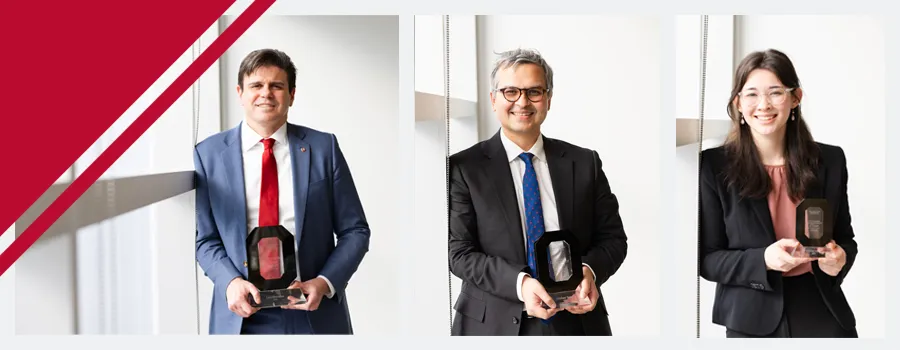
At the Enterprise for Research, Innovation and Knowledge’s annual Research and Innovation Showcase, Luiz Meirelles, Akshay Sood and Hannah Myers were named Ohio State Innovators of the Year.
Innovator of the Year: Luiz Meirelles, DDS, MS, PhD
Luiz Meirelles, assistant professor of Dentistry, was named as The Ohio State University 2026 Innovator of the Year.
The Innovator of the Year award recognizes established Ohio State researchers who are actively working to promote the commercialization of university intellectual property, through invention disclosures filed, patents applied for and/or received, technologies licensed or spin-off companies formed.
“Once you have a good idea, you have a good start, but if you don’t have hardworking people around you, it makes it more difficult,” He added, “We are very lucky to have the support we have from OSU.”
Meirelles is an associate professor in the College of Dentistry and a globally recognized innovator in biomaterials, digital diagnostics and precision surgical technologies. He obtained his DDS in his hometown of Rio de Janeiro, Brazil, and his PhD from the University of Gothenburg, Sweden. He is the inventor of multiple pioneering technologies, including advanced implant surface systems used in more than 300,000 patients globally and next-generation digital platforms that enable highly precise, non-invasive surgical monitoring. His innovations have led to reduced surgical complications, lower healthcare costs, and expanded access to care across international markets.
"I think the inspiration comes from patients,” he said. “Every time we have patients in our chair, as a dentist, you want to have the best outcome. You want to have high precision. We always feel there’s something that we can do to improve.”
Early Career Innovator of the Year: Akshay Sood, MD
Akshay Sood was named Ohio State's Early Career Innovator of the Year. He is a urologic oncologist specializing in treating prostate and bladder cancers with extensive training in robotic surgery and other minimally invasive surgical techniques. His research is focused on developing novel therapies and diagnostic methods for prostate and urothelial cancers through biomarker-driven, investigator-initiated clinical trials.
“The inspiration for all my work came from the patients that I see,” he said. “And although we have made great strides, especially I would say in the past 10 years or so, I think there's a lot of work to be done.”
Sood has received multiple awards for his research, including the prestigious John D. Silbar, MD Award by the American Urological Association, and has authored more than 225 research papers, editorials and book chapters in journals including JAMA Internal Medicine, Journal of Clinical Oncology, BMJ, Annals of Surgery, European Urology and Journal of Urology. He completed several fellowships at University of Texas MD Anderson Cancer Center, Henry Ford Health System and Johns Hopkins University School of Medicine. He earned his Doctor of Medicine at the All-India Institute of Medical Sciences.
Next Generation Innovator of the Year: Hannah Myers
Hannah Myers was named Ohio State's Next Generation Innovator of the Year. She is in her second year of pursuing a degree in Computer Science and Engineering at Ohio State.
The Next Generation Innovator of the Year recognizes postdocs, graduate and undergraduate students involved in innovation and entrepreneurship through contributing to the development or commercialization of a new technology or in recognition of a trainee-initiated start-up company whose success is a result of entrepreneurial talent, creativity and energy.
After thanking family and friends, she went on to thank her mentors in the College of Engineering and staff from the Keenan Center for Entrepreneurship.
“Ohio State's where I found my community and my place,” she added.
Myers’ company PathoTrace is developing a test strip and mobile application designed to identify mold, bacteria and viruses in indoor environments. Its adhesive gel tape passively captures airborne particles, while an indicator system reveals microbial activity through color change. The venture was the winner of the BOSS Space Ventures competition in September 2025.
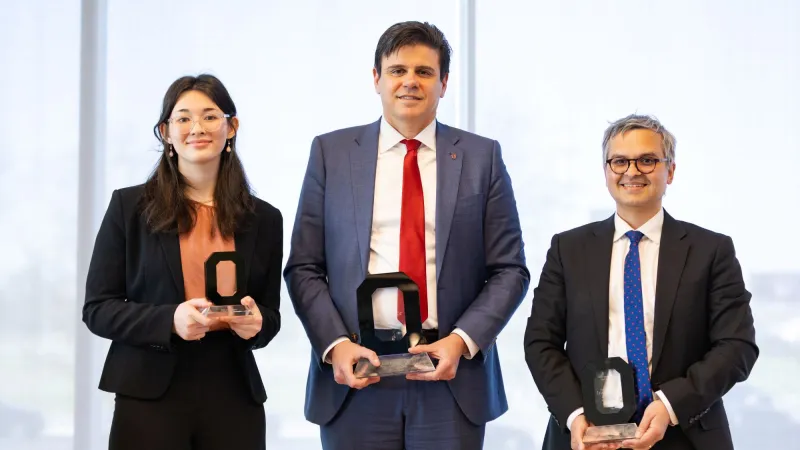

In order pictured left to right, Hannah Myers, Luiz Meirelles and Akshay Sood awarded Ohio State Innovators of the Year.
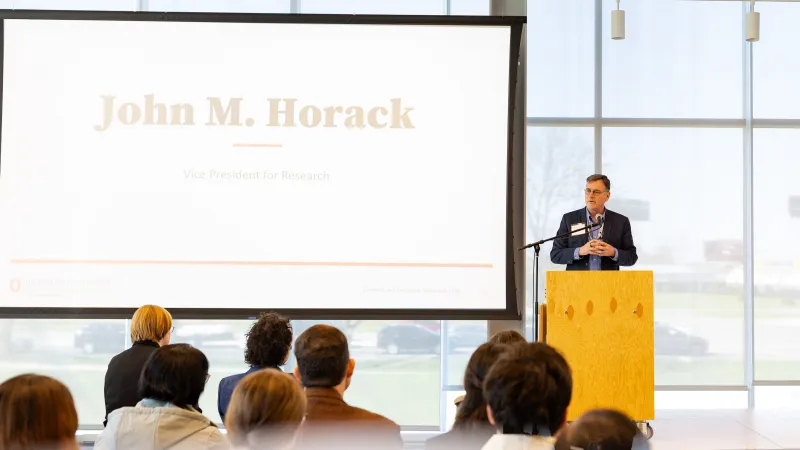
John M. Horack giving the opening remarks at the 2026 Research and Innovation Showcase
2026 Event Highlights
John M. Horack, who emceed the event, opened his remarks by reminding the room why research is important.
“When the world gets to a place where it seems like we're out of airspeed and altitude and ideas, those get replenished through research, through inquiry, through collaboration, through action, through doing hard things that matter,” he said. “There is hope, there is optimism, and there is a future that is worth building.”
He went on to highlight some of the accomplishments in research and creative inquiry over the past year. “Even with all this constant chaos and change and headwinds and turbulence and funding challenges and whatever, take a look back at the layers of equity that you have laid down,” he added.
Some of those accomplishments included celebrating the 25th anniversary of the Honda – Ohio State Partnership and L.S. Fan being awarded the first Pierre Agostini Prize.
He also celebrated Ohio State reaching $1.68 billion in research expenditures in FY25. “Every second, we spend $50 in pursuit of new knowledge – that’s a sign of our vibrancy, especially in the headwinds that we have.”
The event also featured spotlight talks, which featured researchers and innovators telling their own stories of discovery at the university. Featured speakers included:
Carmen Quatman, College of Medicine physician and associate professor
Built for Chaos: Mastering Prevention & Recovery in High-Stakes Medicine
Matthew Steinhauer, College of Arts and Sciences, doctoral student in Japanese Pedagogy,
Unleashing the Constraints of Language
Zak Kassas, College of Engineering, professor
A Look at the Stars: Navigation with Low Earth Orbit (LEO) Satellites
In her acceptance remarks, Myers summed up the hope of the event in an anecdote from her past. “I saw science as a room with an open door, a space I could simply step into and claim as my own. That curiosity never left me,” she said. “Taking those questions, the ones that have kept me up at night, that were scribbled in my journal before drifting into sleep, and turning them into something real, something tangible, and something that helps others.”